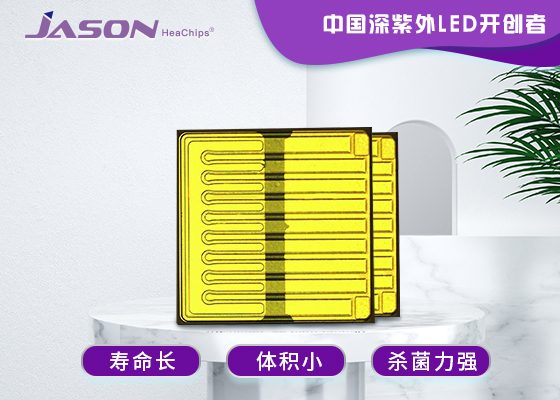
The two bands in this catalogue
| Band | Position | Application named in the catalogue |
|---|---|---|
| 295 nm | Between the disinfection bands and 310 nm | None named — listed as a band only |
| 310 nm | Between 295 nm and the 340 nm endpoint | Phototherapy equipment components |
The neighbouring 280 nm band is one of the disinfection bands; the range closes at 340 nm, the published endpoint of the range. Both named bands sit inside the company's published chip range of 255–340 nm, within the 260–320 nm span the company names as its main production bands. Finished consumer products — lamps for home use and similar retail devices — are not what a chip catalogue supplies; the buyers here are equipment makers integrating emitters into their own validated products.
What these bands are sourced for
- Phototherapy equipment: the 310 nm band is the one the catalogue attaches to phototherapy — see the 310 nm page and the phototherapy application page.
- The 295 nm band: listed without a named application. The application belongs to the buyer's own specification, stated in the enquiry with the tolerance and spectral window the design assumes; supply for a named model is confirmed in the exchange.
How the enquiry differs at these bands
For a disinfection-band enquiry, name the dose basis: irradiance, exposure time and log reduction against a named organism set. For an enquiry at 295 or 310 nm, state the spectral window numerically: the centre wavelength, the tolerance around it, and any bandwidth limit the design assumes, alongside the form to build with, quantities and programme timing. What spectral data and binning records exist for the named model is then established in the enquiry exchange; neither should be assumed from the band name alone.
Forms and confirmation
The catalogue's form families are bare chips, SMD packages and finished modules, but which form one of these bands is supplied in is a per-model question, settled in the enquiry exchange for the exact band and model. Send the band, the spectral window, the intended form and the programme volume in the first message, and ask which form the band is supplied in and what documentation position is recorded for that model.
The two bands
The two bands are 295 nm, listed without a named application, and 310 nm, the phototherapy band. An enquiry names the band, the spectral window, the intended form and the programme volume, and asks which form the band is supplied in and what documentation position is recorded for that model.
Do you supply chips for consumer phototherapy lamps?
The catalogue supplies components to equipment makers, not finished consumer devices. A device maker's finished product carries its own validation and regulatory position; the component conversation covers the emitter — its band, form and recorded ratings.
The record for these bands
Both named bands sit inside the company's published chip range of 255–340 nm and within the 260–320 nm span named as its main production bands. Of the two, only 310 nm carries a named application in the catalogue — phototherapy, in the company's published wavelength keywords; 295 nm is listed as a band only.
Request a quotation
Tell us the wavelength, package format and quantity you are sourcing. Minimum order quantities and lead times are confirmed per product line in the quotation, against the named model and the quantities the enquiry states.
Send an Enquiry