The band this company started with
This history is a process record. Jason spent its first decade building GaN MOCVD epitaxy equipment, and when it turned that equipment on its own product in 2010, the line produced 280 nm deep UV LEDs, with application products commercialised by 2012. A buyer sourcing 280 nm parts here is buying from the company that first produced this band on its own equipment in 2010.
Where 280 nm sits technically
It is one of the catalogue's named bands, inside the published 255–340 nm range, and it is the band this company first produced, in 2010. It sits inside the 260–320 nm span the company publishes as its main production range.
Forms, confirmed per design
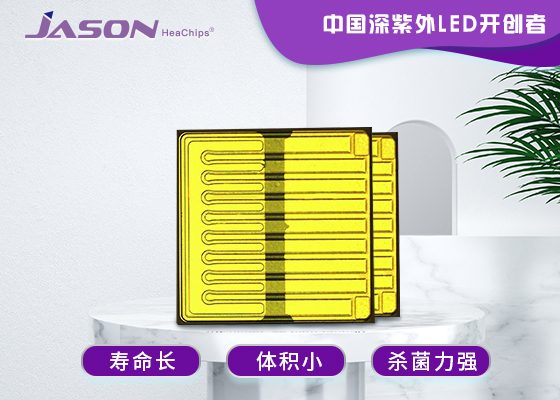
The catalogue's form families are bare VF-series chips, SMD packages in the 3535 and 6868 families, and finished modules for water, air and surface equipment. Which of those forms this band is supplied in — and the per-model ratings in each case — are established in the enquiry exchange, so send the form you intend to build with and the confirmation covers that form directly.
Specifying 280 nm
Ask which optical and electrical ratings are recorded for the named model, and confirm the availability of this band in each of the forms above, in the enquiry exchange. When you enquire, include the target application and duty cycle: where the design runs continuous operation, lifetime-at-duty is as much a part of the specification as initial output, and it is confirmed for the exact device class quoted.
280 nm or 275 nm for a new design?
The band a new design takes follows from the design's own specification — its dose target, duty and validation basis — stated in the enquiry. Which band and form are supplied for that specification is established per model in the enquiry exchange.
What to state in a 280 nm enquiry
State which of two starting points the enquiry comes from: a new continuous-duty design, or a legacy product being re-specified around a 280 nm-class source. Either way, the enquiry states four inputs: the form you intend to build with — bare die, a named package family or a finished module; the duty cycle and daily operating hours the device will actually see; the service interval over which the product must hold its dose; and, for re-specifications, the binning criteria the original validation was written against. Have the model's recorded ratings confirmed against those inputs in the enquiry exchange.
Requalifying a legacy 280 nm design
The route is the standard one — target band and package named in the enquiry, the model's recorded ratings confirmed in the enquiry exchange — with one addition worth requesting explicitly: the binning criteria the original validation was written against.
280 nm in the catalogue record
The band is named in the company's published wavelength keywords, inside the published 255–340 nm range. The company's history records the rest: the UV LED production line built on its own equipment in 2010 produced this band first, and its deep UV application products reached commercialisation in 2012.
Request a quotation
Tell us the wavelength, package format and quantity you are sourcing. Minimum order quantities and lead times are confirmed per product line in the quotation, against the named model and the quantities the enquiry states.
Send an Enquiry