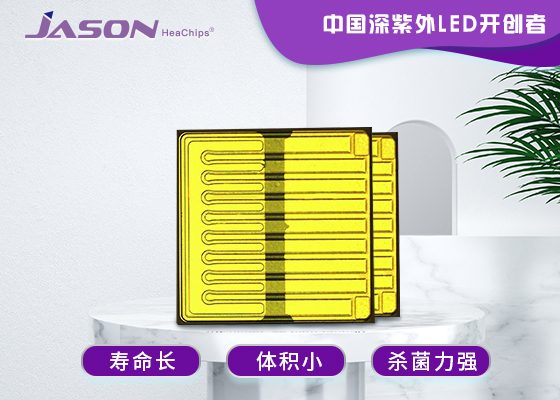
A different job from disinfection
The company's published wavelength keywords attach phototherapy to this band. Form, recorded spectral and electrical ratings, and binning criteria for it are established per model in the enquiry exchange.
310 nm at Jason
The company's published wavelength catalogue lists 310 nm with phototherapy as its named application — the only band in the range with an application of that kind attached. Whether this band is supplied as bare die, or in a specific SMD package format, is established per model in the enquiry exchange. Ask which spectral and electrical ratings are recorded for the named model in the same exchange, and raise spectral bandwidth and binning criteria in the same exchange.
What a device specification names
- Centre wavelength and bandwidth — the centre and bandwidth recorded for the named model, established in the enquiry exchange.
- Field uniformity — the per-device output consistency and binning the design requires, stated in the enquiry.
- Session duty — the duty the device will run: its cycling pattern and cumulative hours, stated by the equipment maker in the enquiry.
- Drive and thermal design — the drive architecture and thermal path the device design provides, stated in the enquiry.
Scope note
Jason's catalogue lists LED components; it does not sell finished medical devices and makes no clinical efficacy claims for components. Therapeutic performance belongs to the finished device and its manufacturer's validation. Which form this band is supplied in — and what ratings are recorded for that form — are established per model in the enquiry exchange, so send your target spectral window, intended package format and programme volume with the enquiry. Equipment makers sourcing emitters for phototherapy equipment will also find the application page on UV LED components for phototherapy equipment useful.
Why component supply, not devices, is the right offer
The distance between an LED component and a treatment device is long: the finished device — its design, validation and clearance — belongs to the equipment maker. A component supplier's part in that chain is the emitter itself: ask what spectral data is recorded for the named model, and which form the band is supplied in, in the same enquiry exchange. Efficacy belongs to finished, validated devices, not to the diodes inside them.
Binning and spectral data at 310 nm
In component terms, two questions go to the enquiry in writing: what wavelength binning is recorded for the model in question, and what spectral data that model's datasheet carries. Neither binning depth nor spectral data is recorded for this band as a standing offer, so neither should be assumed as a standard item of the exchange — specify the centre-wavelength tolerance your array must hold numerically in the enquiry, rather than accepting a nominal centre wavelength alone, and have whatever binning and spectral data exists for the named model confirmed per model in the enquiry exchange.
Stating the array's tolerances in the enquiry
Device makers should treat the two as one specification question — the centre-wavelength tolerance and the output consistency the finished field must hold — and state both in the enquiry. What binning criteria and spectral data can be confirmed for the specific model is settled per model in the enquiry exchange; neither is recorded for this band as a standing offer.
Request a quotation
Tell us the wavelength, package format and quantity you are sourcing. Minimum order quantities and lead times are confirmed per product line in the quotation, against the named model and the quantities the enquiry states.
Send an Enquiry