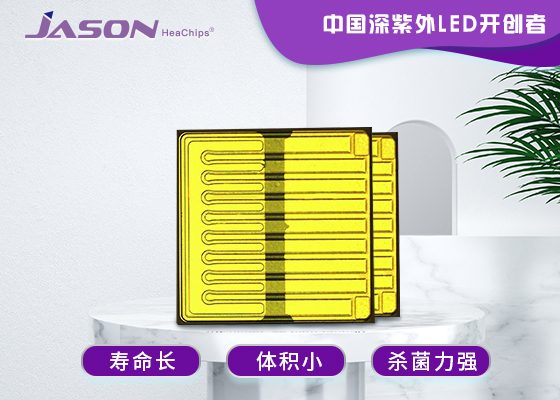
275 nm in the published range
Chips at 275 nm sit inside the company's main production range of 260–320 nm, between the 265 nm and 280 nm named bands.
275 nm at Jason
Chips at 275 nm sit inside the company's main production range of 260–320 nm. Whether this band is supplied as bare die, in a specific SMD package format, or assembled into a water, air or surface module for your design is established per model in the enquiry exchange. In the company's most recent published development news, its team reported developing a 1000 mW-class output 275 nm UV-C device, building on a mass-produced 10 mW product line that the same report rates at 10,000 hours. These are company-published figures, not a rating for any single model: the endpoint definition and test conditions behind them are not recorded in this site's material — ask for them per model in the enquiry exchange.
Application categories, as published
The company's published application categories are water purification, air purification and surface disinfection. Those categories are published at company level; which band a specific product design uses is a per-model matter, confirmed in the enquiry exchange against the design's own specification.
Specifying a 275 nm device
State the dose your product must deliver in the enquiry, with the exposure time and geometry behind it. The same enquiry states the form to build with — chip, 3535 package or finished module — and the form in which this band is supplied is settled in the same exchange. Ask which optical and electrical ratings are recorded for the 275 nm model and form you intend to build with.
Is 275 nm safe to use in occupied spaces?
UV-C is hazardous to skin and eyes at disinfection doses, so 275 nm products are designed as enclosed or interlocked systems — the LED is inside the equipment, not shining into the room. Module designs from this catalogue are intended for integration into enclosed equipment.
The 10,000-hour figure, stated as published
The 10,000-hour figure attached to the company's mass-produced 10 mW line is a company-published figure from its development news. Before designing against that figure, ask in the quotation exchange whether a lifetime basis is recorded for the exact device class you are buying, and what it records — whether it covers an endpoint definition, a maintenance threshold, test conditions and the models the figure applies to, at your drive point and duty. A lifetime figure without its basis is easy to misuse in marketing, so the honest procedure is to treat the published figure as the company's statement about its production line, and to establish per model whether a documented lifetime basis exists behind it and what it says. Designs with a longer service target should raise lifetime-at-duty explicitly in the enquiry, and state the drive point and duty the product will run at, so the confirmation answers the service figure the product actually needs.
275 nm in multi-band product families
Whether each band is supplied in the package family a tier needs, and each variant's footprint and drive requirements, are established per model in the enquiry exchange.
Request a quotation
Tell us the wavelength, package format and quantity you are sourcing. Minimum order quantities and lead times are confirmed per product line in the quotation, against the named model and the quantities the enquiry states.
Send an Enquiry